Assessing the Aging
... assessing cognition in the healthy, the aging, the injured, and the malingering ...
My research with older adults focuses on:
assessing the age-related benefits of attention changes with the Slip Induction Task
measuring long-term effects of mild traumatic brain injury in older adults
developing and disseminating a Fall Risk Prevention Program
designing and testing training approaches to encourage independent living.
developing capacity and infrastructure to conduct research in aging with community dwelling participants
Age-related benefits of attention changes with the slip induction task
Action slips, are seemingly harmless everyday attention errors that can cause accidents or injuries. A widely held assumption is that these errors increase with and become exacerbated by advanced age. This study examines this assumption in older (60 – 80 years) and younger (18 – 25 years) adults with the Slip Induction Task (SIT) wherein participants are occasionally required to deviate from a routine action sequence. We observed that older adults actually experienced fewer attention failures than younger adults, however, they also completed the SIT with a slower pace. In a follow up study, younger adults were required to complete the SIT at a slower pace, like that of older adults from the initial study. While this manipulation did result in increased accuracy, the younger adults still committed more action slips than the older adults. These results suggest that older adults not only value accuracy over speed but they may also invoke a series of strategies to maintain attentive performance in lab-based tasks and perhaps, also in daily life. This project is moving through the review processes with the Journal of Cognition.

Clark & Roy (in review)
cognitive decline in older adults with a history of tbi
This line of research examines whether subtle and persistent effects of a mild traumatic brain injury (TBI) are evident in older adults many years after they sustain that mild injury. Our data indicates that even 30 years after suffering a mild TBI older adult participants were able to achieve accurate performance but at the cost of slower processing speed. It appears that older participants with a history of head injury compensate for their condition by making online adjustments to their reaction time.
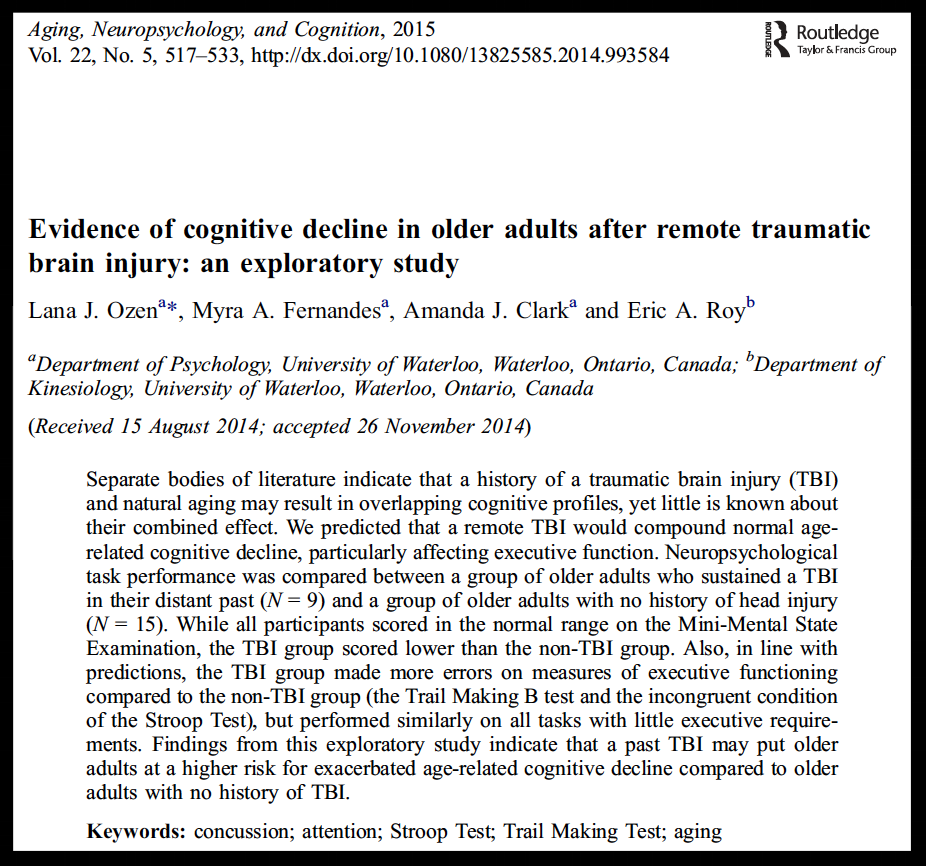
Ozen, L., & Fernandes, M., Clark, A., & Roy, E. (2015)
Published in Aging, Neuropsychology and Cognition
Presented at the Canadian Society for Psychomotor Learning and Sport Psychology
Future research in this area will examine whether those with a history of head injury are more at risk for demonstrating dementia symptomology earlier in life.
PROJECT: an interdisciplinary coalition for fall prevention in the elderly
From 2012 to 2019, I was part of an interdisciplinary coalition of researchers from the departments of Physical Therapy, Nursing, Occupational Therapy and Psychology, members of the Hamilton Country Health department, and numerous community stakeholders. Our mandate is to reduce reduce propensity for falling among the older adults in our community.

Fell, N., Jackson, J., Clark, A., Stanfield, H., Bishop, C., Angwin, C., & Farrar, I. (2018)
* this was in press before my promotion to Associate Professor and was included in my tenure dossier.
My role within this partnership was two-fold, I advised on the role of cognitive health in determining fall risk and I was the program evaluator for the initiative. Our coalition presented posters at numerous national conferences, attracted external funds to support the Matter of Balance Train the Trainer program, offered a Fall Prevention Summit, offered the annual Fall Prevention Days and published how the development of our coalition can be used as a model in other communities in Journal of Interprofessional Education & Practice.

reducing age-related decline in executive function
Executive function declines associated with healthy aging are common and can be associated with changes in one's ability to maintain independence. This area of my research program is focused on developing and testing training approaches to encourage independent living.
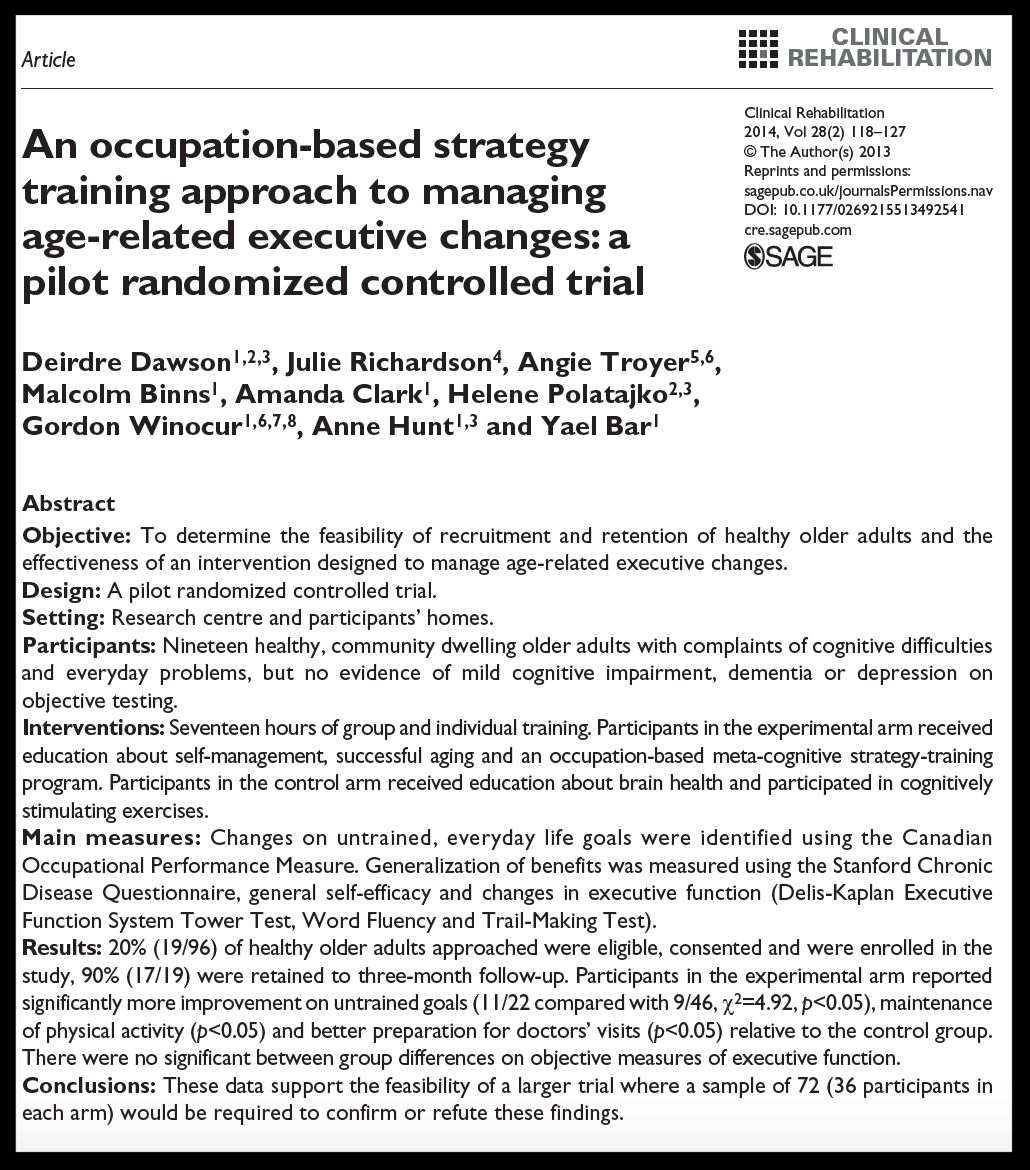
Dawson, D., Richardson, J., Troyer, A., Binns, M., Clark, A., Winocur, G., Hunt, A., Bar, Y., Polatajko, H. & Schweizer, T. (2014)
I collaborated on a project where we:
Published a randomized controlled trial using an occupation-based strategy training approach in Clinical Rehabilitation.
Generated a program the uses a goal-management training technique to improve execution of everyday tasks
Chattanooga Alliance for Research Engagement (CARE)

CARE is an interdisciplinary initiative that exists to build capacity and infrastructure for researchers at University of Tennessee at Chattanooga (UTC) to conduct biomedical and bio-behavioral research with community dwelling individuals as research participants.
The CARE initiative has been presented at more than 20 recruitment events in the Chattanooga community, the database of interested research participants includes approximately 100 individuals and it continues to grow.
Funded by a $1,000 Provost Student Research Award to Allen Nida
Submitted a Collaborative Research Initiatives for Sponsored Programs (CRISP) funding application (not funded)