Assessing the malingering
... assessing cognition in the healthy, the aging, the injured, and the malingering ...
Malingering refers to the intentional exaggeration or fabrication of cognitive, psychological, or physical symptoms for external gain, such as financial compensation, academic accommodations, or avoidance of responsibility. Neuropsychologists assess malingering by using validated performance validity tests and behavioral indicators to distinguish genuine cognitive impairment from deliberate underperformance.
Embedded Executive Function Measures to Detect malingering of TBI
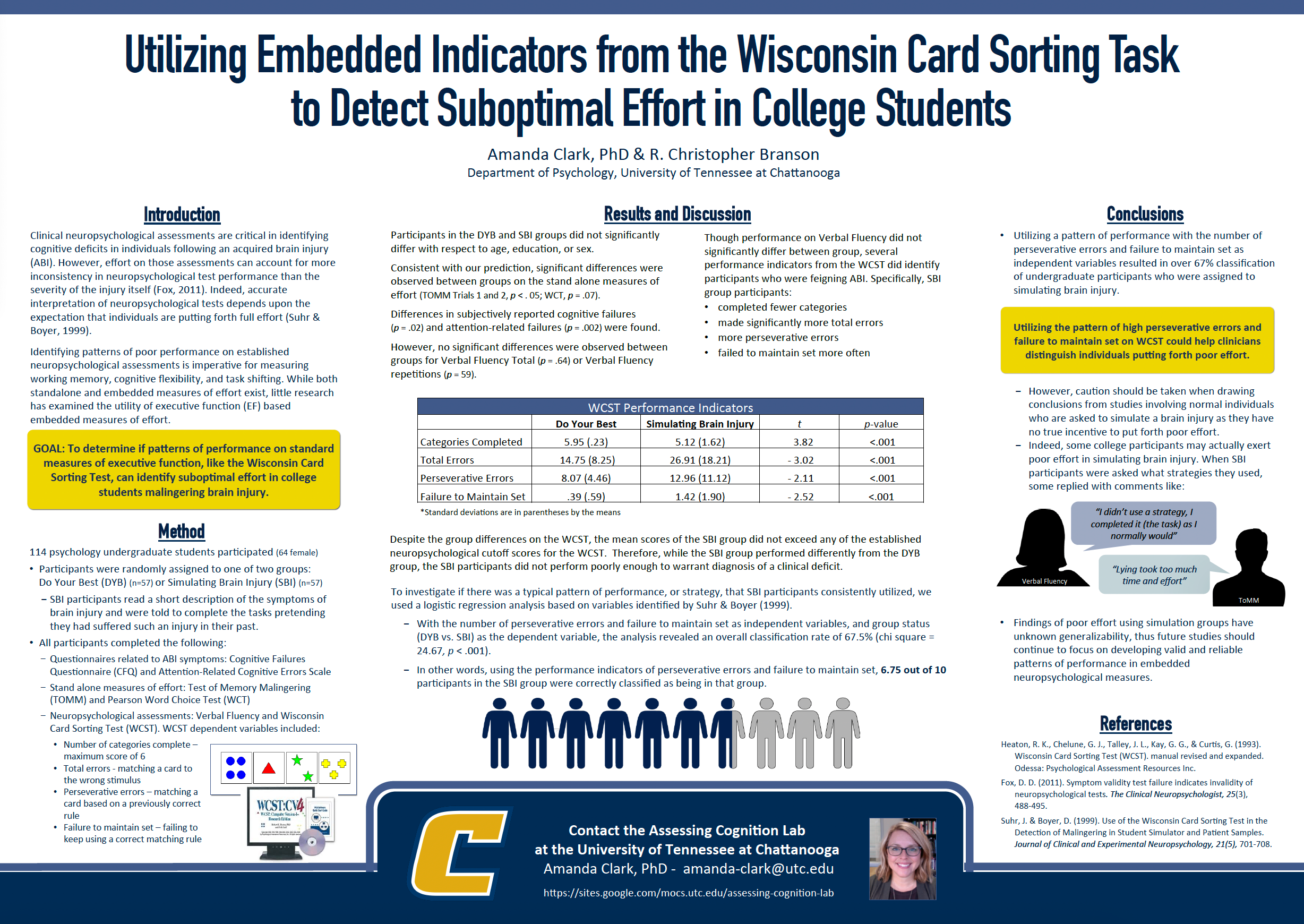
This body of research involves investigating the utility of specific clinical measures of executive function to identify possible malingering. This is accomplished by comparing the performance of neurologically healthy individuals who are feigning symptoms of executive function impairment with the performance of healthy individuals who are simply told to try their best (control group).
We have collected data from almost 200 participants using the Pearson Word Choice test, the Test of Memory Malingering (TOMM) and the Wisconsin Card Sorting Test (WCST). This work was spearheaded by Chris Branson and Kaila Rogers and was funded by a $650 Provost Student Research Award. Portions of this work have been presented in poster format at several regional, national, and international conferences.
This work was continued with Melissa Materia’s graduate thesis where she explored what strategies healthy young athletes would use to intentionally ‘sandbag’ their performance on a baseline assessment so that a future injury may go undetected. In that study, we examined whether the SportGait concussion baseline assessment could detects differences between participants instructed to sandbag and those who were not. Furthermore, we examined whether participants’ cognitive control was related to their ability to fake poor performance on SportGait. Results revealed that “sandbagging” participants endorsed more concussion symptoms, made more errors on the CPT-3, and demonstrated lower stride power in their gait. However, cognitive control did not predict sandbagging performance. Together these results indicate that SportGait detects sandbagging, but additional investigation of factors including the impact of coaching on faking behaviors is needed.


Embedded Measures to Detect malingering of ADHD
Nic Maynard was interested in determining if traditionally used measures of attention and executive function would accurately detect malingering of ADHD better than symptom reporting questionnaires. In his thesis, which he successfully completed in 2024, he assessed college students’ knowledge and perceptions of attention deficit hyperactivity disorder (ADHD) to help identify patterns of behavior in those who malinger ADHD in a college environment. Participants who were instructed to malinger ADHD subjectively reported significantly more symptoms than their neurotypical peers, but not their valid ADHD counterparts. They also responded with a significantly different error pattern on experimental assessments. Alongside a current graduate student, Cooper Mathis and alum, Bailee Smith, these findings were presented at the 2024 meeting of the Southeastern Psychological Association and the team is working on preparing the thesis for publication.


Embedded Measures to Detect malingering of Anxiety
The current students in the Assessing Cognition Lab are Samantha Dean and Cooper Mathis. They are expanding the lab’s work on malingering to explore if traditional measures of working memory and attention - like the Stroop task, n-back task, and SART can be used to accurately and reliability detect malingering of anxiety. They have trained a small army of 4 research assistants and are collecting data in Fall 2025 to defend their theses in Spring 2026.